Overview
We know that natural sounds are restorative. But we rarely encounter them in isolation. In parks, gardens and urban green spaces, natural soundscapes compete constantly with traffic, construction and human activity. Do nature sounds retain their restorative properties when layered over urban noise? And does the intensity or frequency of that urban noise determine the outcome?
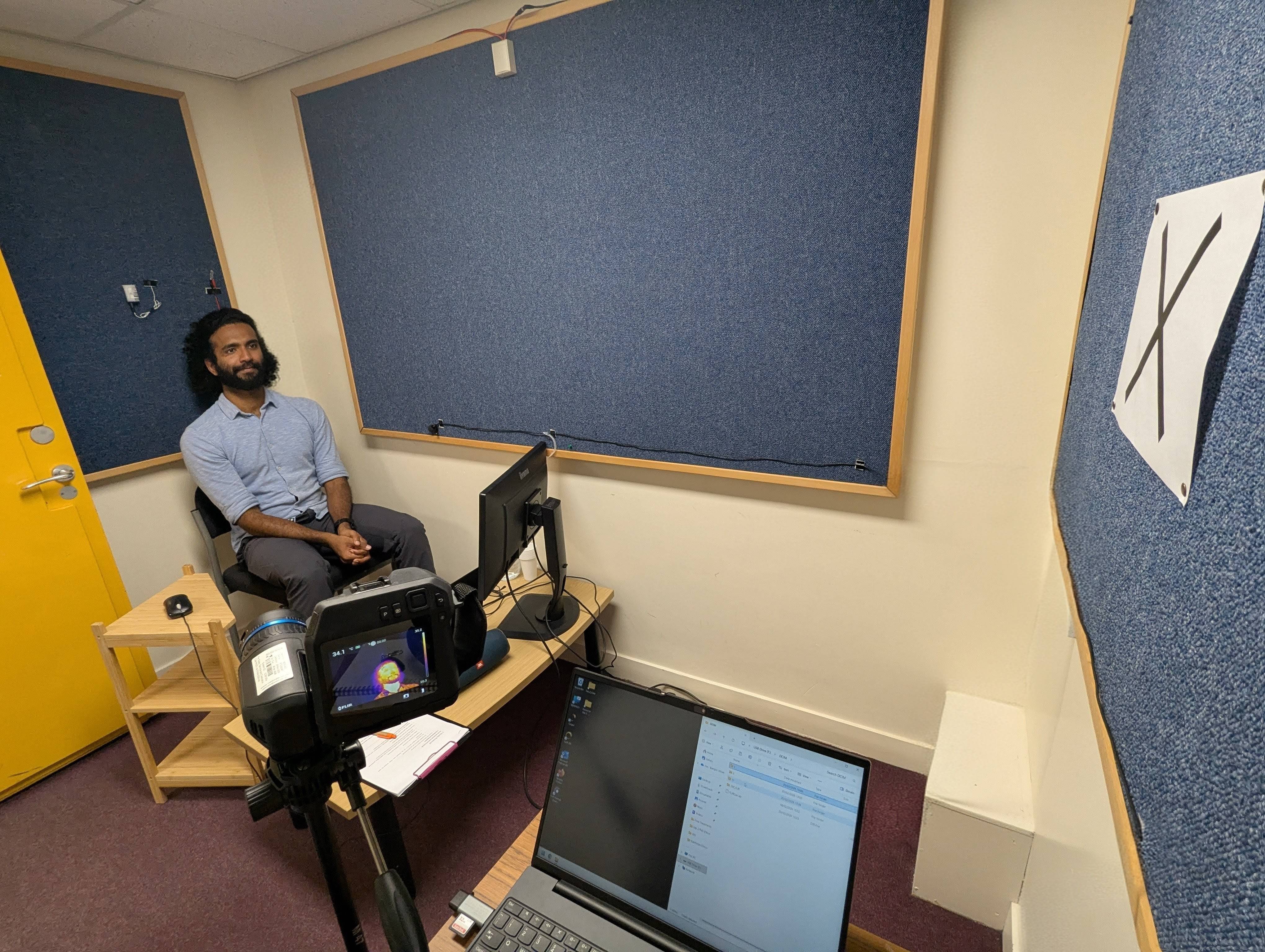
Birdsong was used as the primary proxy for nature sounds in this study, chosen for its ecological relevance and its established role in psychoacoustic research. The study systematically manipulates both the intensity and event rate of urban noise mixed with a fixed birdsong recording. Alongside self-report psychological measures, this study uses thermal imaging to capture real-time physiological responses, providing an objective, non-intrusive measure of how the body responds to each soundscape condition.
Collaboration: This study was conducted in collaboration with Whitney Fleming (Research Fellow, Bangor University).
Background
Urban noise is one of the leading environmental health concerns in Europe. The World Health Organisation estimates that chronic exposure to traffic noise above 55 dB causes measurable health effects including sleep disruption, raised cortisol and increased cardiovascular risk. At the same time, the same urban environments that generate this noise are often home to green spaces where people seek rest and restoration.
Research in psychoacoustics has begun to examine how urban and natural sounds interact, but most studies use only two or three conditions. This study uses eleven distinct soundscape conditions to map the dose-response relationship more precisely: at what point does urban noise overwhelm the restorative signal of birdsong?
A secondary aim is to test whether self-reported and physiological measures of wellbeing converge. If they do, it strengthens confidence in both; if they diverge, it tells us something important about what people are consciously aware of versus what is happening in their bodies.
Study Design
The study used a within-subjects repeated measures design, with each participant exposed to all 11 soundscape conditions in randomised order. Each condition lasted two minutes, structured as: 30 seconds baseline, 60 seconds soundscape, 30 seconds recovery. Psychological measures were taken after each condition.
| Parameter | Detail |
|---|---|
| Design | Within-subjects repeated measures |
| Sample | N = 50 participants |
| Setting | University laboratory |
| Conditions | 11 soundscape conditions per participant |
| Condition duration | 2 minutes (30s baseline, 60s stimulus, 30s recovery) |
| Compensation | £15 gift card |
| Session duration | 90 to 120 minutes |
The Soundscapes
The 11 conditions were constructed from a fixed birdsong baseline combined with urban noise at varying levels of intensity and event rate:
- Birdsong only: A recording of 8 North Wales bird species, normalised to a consistent loudness level
- Silence: An ambient baseline with no identifiable content
- 9 birdsong + urban noise conditions, combining:
| Urban Intensity | Low Rate | Medium Rate | High Rate |
|---|---|---|---|
| Low (50 dB SPL) | Condition 3 | Condition 4 | Condition 5 |
| Medium (70 dB SPL) | Condition 6 | Condition 7 | Condition 8 |
| High (100 dB SPL) | Condition 9 | Condition 10 | Condition 11 |
Urban sounds included car engines, horns and ambulance sirens drawn from sound libraries, edited and mixed to achieve each target intensity and event rate combination.
What We Measured
Participants completed a battery of validated scales after each condition:
- State anxiety (STAI-6): A brief six-item validated measure of momentary anxiety
- Subjective happiness: A single-item 0 to 10 rating
- Noise annoyance: Both verbal (five-point scale) and numeric (0 to 10) measures
- Perceived restorativeness (PRSS-SF): A validated five-item scale measuring how restorative an environment feels
- Restorative outcome: How restored the participant felt after exposure
- Perceived pleasantness: A seven-point rating of each soundscape
- Perceived bird species richness: How many bird species participants thought they could hear
At the end of the session, participants also completed measures of birdsong importance and nature relatedness (NR-6), which allow us to examine whether individual differences in nature connectedness moderate responses to the soundscapes.
Thermal Imaging
A key methodological innovation in this study is the use of thermal imaging to capture physiological responses. A FLIR T865 thermal camera recorded participants' facial skin temperature continuously throughout each session. Changes in facial temperature, particularly around the nose and cheeks, are known to correlate with autonomic nervous system activity and can serve as an index of stress, arousal and relaxation.
Thermal imaging offers several advantages over more invasive physiological measures: it is completely non-contact, requires no equipment to be attached to the participant, and captures continuous data without disrupting the soundscape exposure. Blink rate, also detectable from the thermal footage, provides an additional index of cognitive load and stress.
Analysis of the thermal footage is being undertaken using a Python-based image processing pipeline to extract mean region-of-interest temperatures and blink rates for each condition phase.
Status
Data collection is complete. All 50 participants have completed the protocol and psychological data have been collected. Development of the thermal imaging analysis pipeline is underway. My analytical focus for this study is the thermal imaging data and its relationship to self-reported psychological measures.
The study will proceed to statistical analysis using linear mixed models in R, with soundscape intensity and event rate as fixed effects and participant as a random effect. Results will be submitted for publication on completion.
This study was approved by the Bangor University College of Science and Engineering Ethics Committee. All participants provided informed written consent, including a specific second consent for the use of thermal imaging data. All data are stored and processed in accordance with UK GDPR. No individual thermal images or personally identifiable data are published on this page.